Monday, October 31, 2011

MUCH OF THE WANTON, MUCH OF THE BIZARRE, SOMETHING OF THE TERRIBLE, AND NOT A LITTLE OF THAT WHICH MIGHT HAVE EXCITED DISGUST

The seventh of Roger Corman's Edgar Allan Poe adaptations for AIP, The Masque of the Red Death, opened four years and two days after the first, House of Usher, and that is a whole lot of Poe in not very much time no matter how you slice it (and let us pause to observe that by modern standards, seven movies of any sort in four years is an insane amount of output, and further that the Poe movies represent only about half of his directorial work in that period). It's probably not surprising that at some point, the man was simply going to burn out; and by my reckoning it would appear that this was the moment where that happened. Really, though, it would seem that Corman's infatuation with the series had gone cold pretty fast: the third movie, Premature Burial, was an uncertain retread of the first two, the fourth and fifth were largely parodies, and the sixth, The Haunted Palace, was actually an H.P. Lovecraft movie in Poe's clothing.

Part of the problem was undoubtedly the choice of source material: though one of Poe's most celebrated stories, "The Masque of the Red Death" offers virtually nothing in the way of actual plot, though it is arguably the most perfect exercise in creating atmosphere through prose in the writer's work. More than one-fifth of the rather short tale is dedicated to describe the layout and design of the rooms in which it takes place; that's longer than all of the lines dedicated to fleshing out the "conflict", if I can be so bold. In effect, the entire narrative goes like this: "There was a hedonist, and he did hedonistic things. He had a blue room. He had a purple room. He had a green room. He had an orange room. He had a white room. He had a violet room. Finally, he had a black room with a red stained glass window that was ghastly to be in for any amount of time. One night, he died of the plague."

In order to inflate that to anything resembling a feature film, writers Charles Beaumont and R. Wright Campbell (the latter making not only his first Poe movie, but his first horror movie overall) first grafted one of Poe's last stories, "Hop-Frog", onto the stump of "Red Death" - and why not, they're both easily read as stories of a dissolute nobleman getting his comeuppance - and then came the mad invention. Somewhere in medieval Europe, Prince Prospero (Vincent Price) throws hideously orgiastic parties every night to keep himself amused by enjoying the depths to which human dignity can sink; when he's not doing that, he rides around the countryside being a holy terror to the peasants under his control, plucking away their food and supplies to keep his endless debauch alive. And that is just what he's doing when we first meet him; but today, the locals are fighting back. The two ringleaders prove to be Gino (David Weston) and Ludovico (Nigel Green), and Prospero is about to have them put to death when he is stopped by a pretty young woman, Francesca (Jane Asher): she's Gino's fiancée and Ludovico's daughter. Seeing a new opportunity for cruelty, Prospero offers her a chance to save one of the men; she must choose who will die. The only thing that interrupts his little game is when an old woman whom we saw earlier chatting with a man all dressed in red (John Westbrook) is found dead, oozing blood out of all her pores. Realising that the dreaded Red Death is in the area, Prospero orders an immediate retreat to his castle, dragging the three hapless villagers along to be his playthings, and proceeds to plan the grand bacchanal to end all bacchanals. Literally, as the case turns out, but he doesn't know that yet.

The vast bulk of the film (which, at 89 minutes, is too short to be anything but fleet, though it's one of the longest films in the cycle) consists of Prospero, who we eventually learn to be a Satanist - or what the screenwriters call a Satanist, but for all the talk of faith and God and good and evil (at times the dialogue seems plucked from one of those interminable Bible epics of the '50s), the whole thing doesn't feel like it was written by people with more than a passing familiarity with Western religion, sort of like those weirdly Christian-inflected manga - speaking cruelly and persuasively to Francesca, while Prospero's equally lustful but far less suave friend Alfredo (Patrick Magee) heaps cruelties upon the dwarf exotic dancer Esmeralda (Verina Greenlaw), and thus bringing her lover, the dwarf court jester Hop Toad* (Skip Martin) to the point of murderous revenge.

There's a lot to like, even love, about The Masque of the Red Death, but it suffers from a huge and easily-named flaw: the script is rotten with blind alleys and deadwood. The Prospero and Hop Toad plotlines intersect only inasmuch as they take place in the same location at the same time; eventually, the writers all but yanks the jester bodily out of the picture with one of those old-timey vaudeville shepherd's crooks. And even setting that aside, the A-material, Prospero's long mental torture of the maiden, suffers from being the same scene played out multiple times: the Satanist speaks in silken tones of pure evil, and the girl brightly asserts her Christian faith, though each time she's a little slower on the draw.

It's not an insurmountable script (though it's surely one of the weakest in the series); but it certainly would have taken a director pushing at the material with more urgency than Corman was apparently interested in scrounging up to make it a top-tier Poe movie. Nor is it at all the case that he was sleepwalking: in fact, The Masque of the Red Death represents a striking new way of presenting this Gothic horror, one mired in bright lights, bold colors, and lots of moment. These are all of them the very polar opposite of House of Usher or Pit and the Pendulum; no merely lazy filmmaker would have gone in this direction. Unfortunately, a bored director might have. Ironically, it might even have been this attempt at a new visual scheme that hurts the film: when the other Poe movies hit their slow patch - and all of them have slow patches - they were able to get by on the moody, foggy atmosphere they'd created (the best of them, especially Usher and Haunted Palace, seem to deliberately court these slow stretches just to show off their atmosphere). In this movie, the atmosphere is of a wholly different flavor, still menacing, but not so hulking and brooding, and when things slow down, it's sort of boring.

On the other hand, it probably sounds like I'm picking on something I completely love: the film looks absolutely gorgeous, and I wouldn't give it up for anything. The ubiquitous and desperately necessary Daniel Haller works his magic yet again, while the cinematography was by a largely untested camera operator named Nicolas Roeg - I pray you know that name, and if you don't, then I envy the exciting trip you have ahead of you. Of course, Roeg as DP of a cheap-ass AIP picture is not the same as Roeg directing Don't Look Now and Walkabout, yet there are traces of the phantasmagoric touch he brought to his later movies in the way that bright colors are used like a weapon in this movie, so damn cheery and saturated that they almost start to overload your retinas. Heck, they're so hard and beautiful that I can even overlook the fact that there are only five, not seven, monochromatic chambers, and yellow was not one of the colors in Poe's original list.

The other thing that redeems The Masque of the Red Death, and to an even greater extent, is the lead performance: the supporting cast ranges from pretty good (Magee, Martin) to hopelessly one-note (Asher, Weston), to criminally under-used (Hazel Court, in her third and last Poe movie), but Price is on a level he virtually never doubled. If I hesitate even slightly in calling it his best work in the Poe cycle, I am solely thinking of The Haunted Palace, and both performances would put in a strong claim to being the highlight of his entire career. Here, he's playing a complete and unmediated villain - a Satanist, for chrissake! - but finding an excellent number of shades of that villainy, from the purely malicious to the bored to the self-impressed and urbane. Even despite its clumsy storytelling, the mere fact that The Masque of the Red Death gave Price the chance to play this character in such a way is all the justification it needs to exist, and while I wish it was as potent as the excellent story that inspired it - and I wish, even more, that it was up to the wonderful standard of the best Poe movies - Price is by himself enough to make it essential viewing.

Reviews in this series
House of Usher (Corman, 1960)
Pit and the Pendulum (Corman, 1961)
Premature Burial (Corman, 1962)
Tales of Terror (Corman, 1962)
The Raven (Corman, 1963)
The Haunted Palace (Corman, 1963)
The Masque of the Red Death (Corman, 1964)
The Tomb of Ligeia (Corman, 1964)
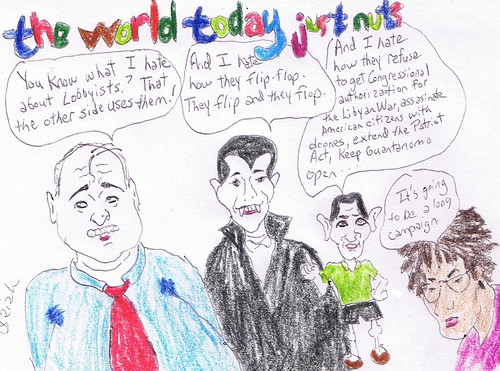
Chris Hedges, Isaiah, Ava and C.I.

Isaiah's The World Today Just Nuts "The Projection Message"


the projection message

I really enjoy that one. I hope you do too. It also captures the messaging that the campaign tried yesterday and what worked so well for them in 2008.

"A Master Class In Occupation" (Chris Hedges, ICH):

The Occupy movements that have swept across the country fuse the elements vital for revolt. They draw groups of veteran revolutionists whose isolated struggles, whether in the form of squatter communities or acts of defiance such as the tree-sit in Berkeley to save an oak grove on the University of California campus that ran from Dec. 2, 2006, to Sept. 9, 2008, are often unheeded by the wider culture. The Occupy movements were nurtured in small, dissident enclaves in New York, Oakland, Chicago, Denver, Boston, San Francisco, Los Angeles and Atlanta. Bands of revolutionists in these cities severed themselves from the mainstream, joined with other marginalized communities and mastered the physical techniques of surviving on the streets and in jails.

“It’s about paying attention to exactly what you need, and figuring out where I can get food and water, what time do the parks close, where I can get a shower,” Friesen says.

Friesen grew up in an apolitical middle-class home in Fullerton in Southern California’s Orange County, where systems of power were obeyed and rarely questioned. His window into political consciousness began inauspiciously enough as a teenager, with the Beatles, The Doors, and Crosby, Stills, Nash & Young. He found in the older music “a creative energy” and “authenticity” that he did not hear often in contemporary culture. He finished high school and got a job in a LensCrafter lab and “experienced what it’s like to slave away trying to make glasses in an hour.” He worked at a few other 9-to-5 jobs but found them “restrictive and unfulfilling.” And then he started to drift, working his way up to Berkeley, where he lived in a squatter encampment behind the UC Berkeley football stadium. He used the campus gym to take showers. By the time he reached Berkeley he had left mainstream society. He has lived outside the formal economy since 2005, the last year he filed income taxes. He was involved in the tree-sit protest and took part in the occupations of university buildings and demonstration outside the Berkeley chancellor’s campus residence to protest fee hikes and budget cuts, activities that saw him arrested and jailed. He spent time with the Navajos on Black Mesa in Arizona and two months with the Zapatistas in Mexico.


That's an interesting take and one I agree with. But reading it, I was struck by how Chris can report and, by contrast, Danny Schechter tries to hector and control at ZNet. I especially found Schechter's comment that "some" said MoveOn was trying to take over OWS. Some?

He's such a kiss ass, such a damn liar. He is the very reason that Chris Hedges had to write Death of the Liberal Class.


"Media: NPR, the angry vagrant" (Ava and C.I., The Third Estate Sunday Review):
But the spot that really ticked off listeners was when Ira accessed a station's donor list, found out that someone hadn't donated since 2002 and called to harass the man. This did not build trust with listeners. As we noted at the top, when you donate to NPR, they ask you if you'd like to be thanked on air or not thereby implying a confidentiality to the relationship. At least until it turned out Ira had access to donor lists and can out whomever he wants on air.

Gary Knell may be smart about many things but this fundraiser demonstrates he's not smart about all things. NPR and its audience are currently in the rockiest relationship in NPR's history. That has to do with the reason the last CEO left, it has to do with the fundraising meeting that was taped by a conservative outlet and made public, it has to do with the nasty way that some on airs have taken to interviewing certain members of Congress, cutting them off in mid-sentence to toss a different question at them than the one they're trying to answer.

All of those were problems for NPR. And many stations just finished (or are finishing) an October pledge drive where NPR came off not needy but damn greedy. Bad enough their nonsense year after year about how you spend more for a cup of coffee each day (we don't drink coffee) and that money could go to NPR. But this go-round they had Ira Glass telling listeners to fork over their money to NPR because "this is a war" and you're either with NPR or you're against it. They had Ira hounding people who told friends they'd pledge but didn't. They had Ira calling up people who once donated to NPR but had not done so in a few years. It wasn't funny and it did not build trust between the listener and NPR. It was the equivalent of standing on the corner waiting for the traffic light to change and being yelled out by an angry vagrant demanding money. For an entity hoping to increase donations, that's bad business.

I don't think I'll contribute to NPR anytime soon. I do not like what either NPR or Ira Glass did in this fundraising cycle. I almost wrote about it here when my NPR was airing Glass' nonsense earlier this week. For about two seconds, I thought, "There may be a post in that." Then I quickly forgot. As Ava and C.I. demonstrate, there was a story there. They did a great job tracing it to NPR's problems from last year, the new CEO and president and his money raising efforts in the past.

"Iraq snapshot" (The Common Ills):
Monday, October 31, 2011. Chaos and violence continue, one year ago today Our Lady of Salvation Church in Baghdad was attacked, US plans to use Kuwait as a stating area finally get serious attention from the US mainstream media, Nouri's screaming "Ba'athists!" again, and more.


Today Mark Thompson (Time magazine) observers, "Just like clockwork, the Administration lets the New York Times know that it's planning to leave a big force in Iraq's 'hood to keep an eye on troublemakers in Tehran, Baghdad and elsewhere." What's he referring to? Saturday (online, Sunday in print) Thom Shanker and Steven Lee Myers (New York Times) reported, "The Obama administration plans to bolster the American military presence in the Persian Gulf after it withdraws the remaining troops from Iraq this year, according to officials and diplomats. That repositioning could include new combat forces in Kuwait able to respond to a collapse of security in Iraq or a military confrontation with Iran." Good for them for noting it, but why didn't anyone note it two Fridays ago (or the Saturday after) when covering Barack's assertions about 'all' troops coming 'home'? As Shanker and Myers note, this has been known for "months." We noted it two Fridays ago. And while it has been known for months, it's funny how so many outlets ignored it that day (the day Barack gave his speech) and in all the days that followed. When criticism got too much for the administration, as Mark Thompson notes, they ran to the New York Times which only then 'found' the story. (See Third's editorial, "Editorial: US press doesn't give a damn about Iraq.") Dar Addustour reports that DC is in negotiations to boost US troops in Kuwait to use it as a staging platform as well beef up its presence in Saudi Arabia, Bahrain, Qatar and the UAE. Al Mada notes Kuwait has been discussed for months but now has "urgency" as the year ends and might end without the US securing 'trainers' in Iraq. The paper notes that this is among the alternative solutions being sought. Mark Thompson explains, "The betting here is that thousands of U.S. troops in Kuwait and elsewhere around the Gulf will keep the lid on any Iraq explosion -- at least until after next year's U.S. presidential eleciton."

It was so very nice of the New York Times to play dumb on this subject until the White House gave them approval to write about it. We're dropping back to a Third feature from November 4, 2007:

Presidential candidate and US Senator Barack Obama who is perceived as an 'anti-war' candidate by some announced that he would not commit to a withdrawal, declared that he was comfortable sending US troops back into Iraq after a withdrawal started and lacked clarity on exactly what a withdrawal under a President Obama would mean.

Declaring that "there are no good options in Iraq," Senator Obama went on to explain that even with his 16 month plan for withdrawal, he would continue to keep US troops in Iraq, agreeing that he would "leave behind residual force" even after what he is billing as a "troop withdrawal."
"Even something as simple as protecting our embassy is going to be dependent on what is the security environment in Baghdad. If there is some sense of security, then that means one level of force. If you continue to have significant sectarian conflict, that means another, but this is an area where Senator Clinton and I do have a significant contrast," Senator Obama offered contrasting himself with his chief opponent for the Democratic presidential nomination. "I do think it is important for us not only to protect our embassy, but also to engage in counter-terrorism activities. We've seen progress against AQI [Al Qaeda in Iraq], but they are a resilient group and there's the possibility that they might try to set up new bases. I think that we should have some strike capability. But that is a very narrow mission, that we get in the business of counter terrorism as opposed to counter insurgency and even on the training and logistics front, what I have said is, if we have not seen progress politically, then our training approach should be greatly circumscribed or eliminated."

The Senator insisted, "I want to be absolutely clear about this, because this has come up in a series of debates: I will remove all our combat troops, we will have troops there to protect our embassies and our civilian forces and we will engage in counter terrorism activities. How large that force is, whether it's located inside Iraq or as an over the horizon force is going to depend on what our military situation is."


That's pretty clear. We wrote it at Third using the transcript of the interview conducted by Michael Gordon and Jeff Zeleny. As we pointed out in the November 2, 2007 snapshot:

On the subject of Iran, Barack Obama appears on the front page of this morning's New York Times.
War pornographer Michael Gordon and Jeff Zeleny who lied in print (click here, here and here -- the paper finally retracted Zeleny's falsehood that should have never appeared) present a view of Barack Obama that's hardly pleasing. Among the many problems with the article is Obama as portrayed in the article -- and his campaign has issued no statement clarifying. The Times has the transcript online and from it, Barack Obama does mildly push the unproven claim that the Iranian government is supporting resistance in Iraq. Gordo's pushed that unproven claim repeatedly for over a year now. But Obama's remarks appear more of a reply and partial points in lengthy sentences -- not the sort of thing a functioning hard news reporter would lead with in an opening paragraph, touch on again in the third paragraph, in the fourth paragraph, in . . . But though this isn't the main emphasis of Obama's statements (at any time -- to be clear, when it pops up, it is a fleeting statement in an overly long, multi-sentenced paragraphs), it does go to the fact that Obama is once again reinforcing unproven claims of the right wing. In the transcript, he comes off as obsessed with Hillary Clinton. After her, he attempts to get a few jabs in at John Edwards and one in at Bill Richardson. Here is what real reporters should have made the lede of the front page: "Presidential candidate and US Senator Barack Obama who is perceived as an 'anti-war' candidate by some announced that he would not commit to a withdrawal, declared that he was comfortable sending US troops back into Iraq after a withdrawal started and lacked clarity on exactly what a withdrawal under a President Obama would mean." That is what the transcript reveals. Gordo really needs to let go of his blood lust for war with Iran.


The New York Times could have published a story on this issue in 2007 but didn't. They did publish an expurgated transcript to the interview (that's what we used as source material for the piece at Third -- and all quotes in the Third article were from that transcript). It's a shame scribes for the Times are unaware what's in their own archives but it's a greater shame that when they had a real story in 2007, they pulled their punches and refused to inform readers the story they really had about 'anti-war' candidate Barack.

Simon Tisdall (Guardian) ponders the staging area plan, "Exactly what the Pentagon might do with its expanded Kuwait and Gulf-based forces, should Iraq implode again at some future date or become destabilised by the unrest in Syria, is unclear. A second invasion would not command much public support, to put it mildly. If, on the other hand, the new American deployments are primarily about containing, intimidating or potentially attacking Iran, the emerging picture becomes more comprehensible, although not more reassuring." Lara Jakes (AP) reports Ali Akbar Salehi, Foreign Minister of Iran, sees this as an attempt "to meddle" in Iraq's "internal affairs." Jakes notes US Secretary of Defense Leon Panetta's remarks that approximately 40,000 US troops will be stationed in the region. Coming home? Leaving the region? Another blow to Barack's big 'withdrawal' speech.


"The crackdown on ex-Ba'athists started earlier this month," Kelly McEvers observed today on Morning Edition (NPR -- link is audio and text). And the crackdown sees a response from the provinces. Thursday, Salahuddin Province's council voted to go semi-autonomous. Iraq has 18 provinces. Three make up the semi-autonomous Kurdish Regional Government. Salahuddin Province's vote was to move towards that sort of relationship. (A form of federalism once advocated by Joe Biden when he was in the Senate.) The next step would be a referendum (that Nouri al-Maliki's government out of Baghdad would have to pay for) and, were the popular vote to back up the council and were the rules followed (always a big if with Nouri as prime minister), Baghdad would control only 14 provinces (of the 18). Though some outside the province are attempting to dispute that the council had the right to vote on the issue, the measure's apparently very positive with the residents (which would explain the 20 to zero vote on the council -- eight members were not present for the vote). Over the weekend, Al Mada reported that people turned out throughout Salahuddin Province (including in Tirkrit, Samarra, Dhuluyia and Sharqat) on Friday to take to the streets after morning prayers and demonstrate in support of the council's vote. Ahmed Abdul-Jabbar Karim, Deputy Governor of the Province, is quoted stating that this decision is something that the officials will not retreat from and that it was backed by the voice of the people. Various State of Law members are quoted offering varying reasons why the vote was wrong or doesn't matter. State of Law is Nouri's political slate. Friday, residents of Anbar Province took to the streets advocating for their province to follow Salahuddin's lead.


Saturday Nouri al-Maliki issued his own response. What does Nouri do when he's unhappy? Accuse them of being Ba'athists. So it's no surprise that Ahmed Rasheed (Reuters) quoted a statement from Nouri declaring, "The Baath Party aims to use Salahuddin as a safe haven for Baathists and this will not happen thanks to the awareness of people in the province. Federalism is a constitutional issue and Salahuddin provincial council has no right to decide this issue."


Nouri, of course, sees Ba'athists everywhere. Al Mada noted that the campaign against so-called Ba'athists allegedly plotting a coup continues with at least 560 Iraqis arrested by his forces, on his orders in the last week. The article notes Ayad Allawi (leader of Iraqiya) has called the arrests illegal while MP Mahmoud Othman has stated these arrests are not helping to build cohesion or a strong government. Rebecca Santana (AP) noted 615 arrests and observed, "Sunnis say that Baghdad sometimes uses crackdowns on Baathists as a tool to exert political pressure." Al Mada states Nouri's threatening to cut off water to the province. Laith Hammoudi (McClatchy Newspapers) explained, "Salahuddin officials said the timing of the vote was spurred by the recent firing of more than 100 professors at Tikrit University for alleged Baath Party connections, and by a nationwide roundup of Baathists in the course of this week." Hammoudi also counters Nouri's claims that he and the Parliament must okay any decision by a province to become semi-autonomous, "In actual fact, article 119 of the Iraqi constitution requires only that a referendum be held in a province following a request for regional status by one-third of the members of the provincial council, or one-tenth of the population." Aswat al-Iraq adds, "The chairman of the Higher Electoral Commission declared that any requests to form a region should be submitted to the Cabinet, underlining that some media organs are reporting inaccurate information with regards to this matter." Who is right? According to the Constitution, Laith Hammoudi's report is correct. From the Iraqi Constitution:


Article 119:

One or more governorates shall have the right to organize into a region based on a request to be voted on in a referendum submitted in one of the following two methods:
First: A request by one-third of the council members of each governorate intending to form a region.
Second: A request by one-tenth of the voters in each of the governorates intending to form a region.


That's the Constitution on the matter, there are no articles or sub-clauses on the issue. Per the Constitution, Salahuddin Province has already met step one. Step two shouldn't be too hard since only 10% of the voters are required to sign off on the request.

Aswat al-Iraq reports, "A conference on federalism was convened today in Basra, aiming to press the central government to expedite the formalities to declare the province a region. Kareem al-Jabiri, an organizer, said that the people of Basra wanted the federal option in the province, whose people suffer of negligence despite its enormous resources."


An Iraqi woman explained to NPR how the crackdown works, "They searched our houses, tossed our furniture. Some of the men on the arrest list are more than 70 years old. You think they're planning to overthrow the country?"


Dar Addustour notes that Parliament's Committee of the Regions is exploring amendments to the the Constitution's Article 119. Faraj al-Haidari, of the Independent High Electoral Committee, continues to insist that there's a governing law that requires provinces to seek permission from the Cabinet. There is no such law in the Constitution. But this may be an indication that when Nouri attempted his seizure of the IHEC last January, he had managed to managed to muzzle them. Al Mada reports Nouri told Salahuddin officials yesterday that their move towards semi-autonomy was destroying national unity. (Saturday he was screaming they were Ba'athists so his latest whine could be seen as an improvement.) Alsumaria TV notes Salhauddin Province's Sabhan Mulla Jiyad responding, "Maliki's assertion that the ministerial council will refuse to declare Salahuddin as an autonomous region is strange and possibly rushed. The Constitution grants us the right to establish a region." In related news, Dar Addustour reports Iraqi President Jalal Talabani that the borders of some governorates need to be changed/fixed. He most likely is referring to Dahuk, Erbil and Sulaymaniyah which are part of the KRG.

Reuters notes a Khan Bani Saad home invasion that resulted in the death of 1 Sahwa and his brother, and, dropping back to Sunday for the rest, an attack on a Baquba military checkpoint in which 1 Iraqi soldier was killed and when other soldiers responded a bomb went off claiming the lives of 2, and an attack on the Bakuba Patriotic Union of Kurdistan left two guards injured.
And on any hopes for democracy? Don't bet your savings just yet. Mvelase Peppetta (Memeburn) reports alarm that the government of Syria has "internaet censorship equipment." It's illegal, according to US law, for it to have this Blue Coat Systems 'filter.' How did it get it? Apparently from Iraq. The US government okayed the sale of web censorship equipment to Iraq. Did the US government bother to run that past either the Iraqi people or the American people? No. Nor did it publicize the sale.
A year ago, Our Lady of Salvation Church in Baghdad was assaulted. Aidan Clay (International Christian Concern) reports:


Today marks the anniversary of last year's four-hour siege on a Syriac Catholic church in Baghdad that ended with al-Qaida linked militants massacring 58 worshippers. The attack was the worst against Iraqi Christians since the U.S.-led invasion in 2003 and enticed many of the already dwindling Christian population in Baghdad to leave the city permanently.
"We've had enough now. Leaving Iraq has become a must," Jamal Habo Korges, a Christian mechanic and father of three, told the United Nation's humanitarian news outlet IRIN. "We've been suffering since 2003 and we can't take it anymore. The latest carnage is the final warning."
Father Douglas al-Bazi, who was kidnapped and tortured four years earlier, told The Christian Science Monitor after the attack that his Chaldean parish in Baghdad had dwindled from 2,500 families in the 1990s to less than 300.
"Of course I cannot ask anyone to stay," he said. "Everyone tells me 'Father, I am sorry - I will leave.' I tell them, 'Don't be sorry, okay? No one is pushing you to die, what's the benefit of dying?'"
Iraq's Christian population prior to 2003 was estimated at one million or more. Today, fewer than 400,000 remain. Those who leave either become internally displaced - most toing to the less violent Kurdish north - or flee the country altogether.


NOW Lebanon reports, "Maronite Patriarch Bechara Boutros al-Rai on Monday headed to Iraq for an official visit." Lebanon's Daily Star adds he'll be performing the Mass at the Church on the first anniversary of the attack:


The delegation, scheduled to leave Beirut airport shortly before midday Monday, includes Bishop Camille Zaidan and Environment Minister Nazem al-Khoury, on behalf of President Michel Sleiman.

[. . .]
Rai is expected to hold talks with a number of Iraqi officials before his return home Wednesday evening.


In the year since the attack, Nouri al-Maliki's accomplished nothing to help Iraq's Christian population. Not at all surprising when the official government response in the week after the attack was to turn around and attack France which offered medical care to the wounded. France opened the door and took the wounded in, airlifted them in at no cost to Iraq, provided them with medical treatment at no cost to anyone and the response to that humanitarian gesture was for Nouri's government to condemn France's kindness.

Alan Holdren (Catholic News Agency) notes the dead from the attack included "three children, two priests and a pregnant woman" and that they were remembered today at Rome's Santa Maria in Mass. Father Mukhlis Shisha remembers, "Father Thair Sa'adallah was just beginning his homily after having read the Gospel. When he saw the terrorists enter, he took the Gospel in hand and held it up, saying, 'In the name of the Gospel, leave them and take me. Me for them!'" He also remembers Father Wasseem Sabb'ieh was able to get two families out of the church and, "Before he closed the door, one of the people he helped said to him, 'Father, leave them and come with us and you will be saved.' He answered, 'I won't leave them like this' and he locked the door." Amelie Herenstein (AFP) reports Iraqi Christians ("hundreds") were at the Church today including Nofal Sabah who has a brother who "was wounded and was being treated in Lyon, Franche, while another 'has psychological problems because he saw everything'." He reports his family is attempting to leave Iraq but are unable to get visas. (The AFP article has an uncredited photo of women in the church lighting candles.)


In the Kurdistan Regional Government, where many Iraqi Christians have resettled, you have efforts between the KRG and various religious bodies to build churches -- a Baptist Church, a Catholic Church, etc. The KRG has been much more responsive to the issue of religious persecution than has Iraq. From the October 21st snapshot:

John Pontifex (Scottish Catholic Observer) reported earlier this month on the increase in Ankawa's Christian population noting that "1500 have arrived within the last year alone" and that "Christians arriving in Ankawa have fled not only from the Iraqi capital but from all across the country -- Mosul in the north, Kirkuk in the north-east, and even Basra, hundreds of miles away in the extreme south." Rob Kerby (Belief Net) notes that the Kurdistan Regional Government is offering Iraqi Christians "plots of land as well as $10,000 per family to settle in the village of Se Ganian, whose population was murdered by poison gas during Saddam's campaign against the Kurds." Joni B. Hannigan (Florida Baptist Witness via Asia News) adds, "The Grace Baptist Cultural Center in Dohuk [Province, in the Kurdistan Regional Government] -- a partnership between Iraqi, Jordan, Brazilian, American and Lebanese Baptists -- is being built with the blessing of Iraqi Kurdistan's Regional Government, who donated the $2 million properly. The land is in the same village, Simele, where in 1933 an estimated 6,000 Assyrians and Chaldeans were slaughtered by the Iraqi government following the withdrawal of British troops from the region after a treaty granting Iraq's independence in 1930."


Where did Iraq's Christian population go? Over 1.5 million before the start of the war, down to less than 500,000 today. Internally, it shifted from throughout Iraq to the KRG. But many more elected to leave the country becoming part of Iraq's refugee population -- the largest refugee population in the region since 1948. If you think the US has opened the doors, you may be remembering campaign promises from Barack. Those promises were long ago set aside and no one in the press appears to care. There were target goals for admitting Iraqis to this country. They are fiscal year targets. October 1st the new fiscal year started. No one pressed the White House or State Dept for those figures (they haven't been pressed since the fall of 2009). No one notes that they don't meet the established numbers.


It's not often James Dao comes off foolish but it does happen. It happened today at the New York Times' blog when Dao elected to write about a white wash 'study' on burn pits which finds they aren't at all responsible for breathing problems or other problems. Dao foolishly writes that, "The report by the Institute of Medicine, an independent policy organization, [. . .]" That may be the but "the Institute of Medicine" did not write the report -- individuals did. For example, John R. Balmes who, as the end notes to the report (Appendix A) explain, has his research "funded by the U.S. Centers for Disease Control and Prevention." Or David J. Tollerud 'forgets' to note that's he's working on a Jefferson County children's study currently -- "the largest government-funded long-term study." It's funny how he 'forgot' that. Any reporter should grasp that there are rewards to be grabbed in scientific America by insisting the burn pits weren't harmful and that those on the government dole would have incentive to be less than forthcoming. (And, yes, we can continue the government funding connections with nearly everyone listed who took part in the 'study.' Most, like Tollerud, 'forget' to note their government funding connections -- disclosures of conflicts of interest apparently having gone out of fashion.)

Staying with the topic of burn pits. Burn pits have resulted in many service members and contractors being exposed to chemicals and toxins that have seriously harmed their bodies. The Senate Democratic Policy Committee held hearings on this issue when Byron Dorgan was the Chair of the DPC. Click here to go to the hearing archives page. A registry is something that Leroy and Rosita Lopez-Torres are now working on. It should be noted that were it not for US Senator Jim Webb, the nation would already have such a registery. In October 21, 2009, then-Senator Evan Bayh appeared before the US Senate Veterans Affairs Committee explaining the bill for a registry he was sponsoring, advocating for it.


I am here today to testify about a tragedy that took place in 2003 on the outskirts of Basra in Iraq. I am here on behalf of Lt Col James Gentry and the brave men and women who served under his command in the First Battalion, 152nd Infantry of the Indiana National Guard. I spoke with Lt Col Gentry by phone just this last week. Unfortunately, he is at home with his wife, Luanne, waging a vliant fight against terminal cancer. The Lt Col was a healthy man when he left for Iraq. Today, he is fighting for his life. Tragically, many of his men are facing their own bleak prognosis as a result of their exposure to sodium dichromate, one of the most lethal carcinogens in existence. The chemical is used as an anti-corrosive for pipes. It was strewn all over the water treatment facility guarded by the 152nd Infantry. More than 600 soldiers from Indiana, Oregon, West Virginia and South Carolina were exposed. One Indiana Guardsman has already died from lung disease and the Army has classified it as a service-related death. Dozens of the others have come forward with a range of serious-respiratory symptoms. [. . .] Mr. Chairman, today I would like to tell this Committee about S1779. It is legislation that I have written to ensure that we provide full and timely medical care to soldiers exposed to hazardous chemicals during wartime military service like those on the outskirts of Basra. The Health Care for Veterans Exposed to Chemical Hazards Act of 2009 is bipartisan legislation that has already been co-sponsored by Senators Lugar, Dorgan, Rockefeller, Byrd, Wyden and Merkley. With a CBO score of just $10 million, it is a bill with a modest cost but a critical objective: To enusre that we do right by America's soldiers exposed to toxic chemicals while defending our country. This bill is modeled after similar legislation that Congress approved in 1978 following the Agent Orange exposure in the Vietnam conflict.


An important bill but one that never got out of Committee. Iraq War veteran Leroy Torres and his wife Rosie Torres have continued to battle on behalf of veterans exposed to burn pits and contiuned to educate the nation on the issue. The Torres have a website entitled BURNPITS 360. They are also on Facebook. It's a personal issue, Capt Leroy Torres was exposed to the burn pit on Balad Airbase. They note that a member of Congress is working on the issue.


From: The Honorable W. Todd Akin
Dear Colleague;
Please sign on to be an original cosponsor to legislation that is important to our veterans.  Numerous veterans have suffered serious health problems after exposure to open burn pits in Iraq and Afghanistan. This legislation will establish a registry, similar to the Agent Orange Registry and the Gulf War Syndrome Registry.  This is the first step toward providing better care for veterans who have been affected by open burn pits.
This legislation is already supported by the Veterans of Foreign Wars (VFW), American Veterans (AMVETS) and the Association of the United States Navy (AUSN).  And the issue of burn pits was recently reported on in the October 24th edition of USA Today (which can be found here) http://www.usatoday.com/news/military/story/2011-10-24/gulf-war-illness/50897804/1
This bill will also be introduced in a bipartisan/bicameral fashion with companion legislation being introduced by Senator Tom Udall (D-NM)
This bill is scheduled to be introduced on November 3rd, so please contact my office soon to become an original cosponsor.
Sincerely,
W. Todd Akin
Member of Congress


Rep. W. Todd Akin

Open Burn Pit Registry Act of 2011

Department of Veterans Affairs

Based on recent accounts of health maladies of veterans returning from Iraq and Afghanistan and a possible link to toxic fumes released in open burn pits it has become necessary to voluntarily track and account for these individuals. 
This registry will ensure that members of the Armed Forces who may have been exposed to toxic chemicals and fumes while serving overseas can be better informed regarding exposure and possible effects. This legislation
is modeled after legislation that created the Agent Orange Registry and the Gulf War Syndrome Registry.
As drafted, the purpose of the
Burn Pit Registry  (bill text found here) is to:
• Establish and maintain an open burn pit registry for those individuals who
may have been exposed during their military service;
• Include information in this registry that the Secretary of the VA determines applicable to possible health effects of this exposure;
• Develop a public information campaign to inform individuals about the
registry;
• Periodically notify members of the registry of significant developments associated with burn pit exposure.
In order to ensure that the Veterans Administration conducts the registry in the most effective manner, the legislation:
• Requires an assessment and report to Congress by an independent
scientific organization;
• This report contains an assessment of the effectiveness of the Secretary
of the VA to collect and maintain information as well as recommendations
to improve the collection and maintenance of this information;
• The report will also include recommendations regarding the most effective
means of addressing medical needs due to exposure;
• This report will be due to Congress no later than 18 months after the date
which the registry is established.
• CBO states that this registry would cost $2 million over 5 years
(2012-2016)
We learned from this country's issues with Agent Orange that the need to get
ahead of this issue is of paramount importance. 
The establishment of a burn pit registry will help the VA determine not only to what extent the ramifications of burn pits may have on service members but can also be of great use in information dissemination. 
If you have any questions please contact Rep. Akin's office at 5-2561 and speak
Visit the e-Dear Colleague Service to manage your subscription to the available
Issue and Party list(s).


NIGHT OF THE DEMONS, PART II

Part of the Italian Horror Blog-a-thon hosted by Hugo Stiglitz Makes Movies

I have a terrible secret, but I trust all of you enough to admit it: I don't dislike Demons 2. The film has a fairly cast-iron reputation for being a cheaper, stupider retread of Demons - not, in and of itself, a movie that can be rightly called an unassailable classic outside of the extremely circumscribed world of 1980s Italian horror buffs - that is incoherent and strange in all the wrong ways (whereas Demons is incoherent and strange in all the right ways. I concede that Demons 2 is not a patch on its predecessor; and while its Italian subtitle translates as The Nightmare Returns, it could just as easily be called Basically the Same Thing, but in an Apartment Building This Time. Plainly, less money was spent on make-up and effects, and the characters frequently make no sense, and it's pretty much impossible to say why the things in the movie happen. Though this last was also true of the original, and it's really tricky to say that one of them is more or less incomprehensible than the other.

But anyway, as I said, I didn't dislike it. Which is arguably not the same thing as liking it, and God knows the film suffers from more than its fair share of shortcomings. Yet I am partial to it anyway. It's dopey as hell, dopier by far than Demons at any rate, and maybe this is part of its charm. Certainly the level of "why the hell not?" enthusiasm that Bava and Argento evidently sank into this second chapter is addictive in the same way that a sugar rush can be - while the "cool" factor of the original has been sacrificed (despite the presence of New Wave on the soundtrack that was, I assume, not so hackneyed in 1986 as it plays today; and at any rate, heavy metal is more the stuff of a rampaging zombie/demon army, n'est-ce pas?), the second film may even be a touch more fun, on account of taking itself even less seriously.

A sign of how far off the rails the script went for this one can be found in the fact that different summaries of the plot don't even necessarily agree on the content of the first act. There are four teenagers who have broken into the demon quarantine zone established at the end of the last movie because teenagers are all inveterate adrenaline junkies* and they like to break into places clearly marked with signs reading approximately "YOU WILL BE KILLED AND EATEN BEYOND THIS POINT STOP FOR FUCK'S SAKE". And they, naturally, run into demons; and this is all happening on TV, though what, exactly, the relationship of the on-TV events to the people watching is part of what nobody seems to agree on - I got that it was a movie-of-the-week thriller, but I've also heard it argued that it was a documentary, or even a live newscast.

Anyway, the important bit is that in a hyper-modern high-rise apartment, just about everybody seems to have their TVs tuned to this program, among them Sally (Coralina Cataldi Tassoni), a girl celebrating her 16th birthday. She is about to get the worst present ever: for reasons that none of the four screenwriters are remotely interested in exploring, one of the demons suddenly turns to the camera and breaks out of her television. Thus is Sally demonised, and it takes only a little bit of time before she's turned most of the building alongside her. The few survivors fight back, ineffectually of course - once again, the DNA of a zombie movie is in here, and no right-thinking Italian zombie movie would want to cash out with anything more than a 5% survival rate among the named characters.

I have, it is true, focused mostly on the ways that Demons 2 is not like Demons, but truthfully, that's not most of what there is to talk about. It's not exactly the case that every incident is copied, but the overall structure of the thing is matched down to the very minute in some places, including the arbitrary introduction of a gang of music-loving toughs who muddle their way into the kill zone for essentially no discernible reason. And in this respect, Demons 2 is aggravating, particularly since the lowered budget means that all of these awfully-familiar demon attacks and the like are not nearly as convincing or disgusting & thus not as discomfiting.

Nor does the removal of the scenario to the high-rise do much good: I imagine the idea was that "holy hell, they can come into your living room!" which is a nominally scary idea, but the building we see is so transparently a set with such obviously production-designed rooms that it absolutely does not register as a normal space for the horror to be intruding upon. That being said, all of the film's very best moments both manage to key into that exact sense of the homey and familiar being horribly violated: an awfully cute dog turning into some nightmare beast in an effect that isn't offensively close to the dog-monster from The Thing; later on, the single nastiest death in the whole picture is given to a child (played by a dwarf in make-up). I do understand that I run the risk of sounding like a complete sociopath right this minute, but I kind of have to give major respect to a movie willing to Go There with a kid (see also: Night of the Living Dead - Lamberto Bava plainly did), because it's one of the only genuinely transgressive things a movie can do, and when it doesn't feel absolutely cheap and exploitative - and knowing that it wasn't an actual child actor involved helps with that feeling - it can be as devastating as anything else in the genre.

That both of these moments are spoiled by subsequently awful effects, well, that's why this isn't an actual "good" movie: the dog has bright green glowing plastic eyes, the kid erupts into a monster that looks precisely like Bava asked the effects team to make one of the titular beasts from Gremlins, but not family-friendly.

At any rate, the whole thing feels unmistakably cheesy, lacking the atmosphere of the malevolent movie theater that worked so darn well in the original (and the attempted commentary on TV culture, if it is there at all, is not a tenth as interesting as the self-parody of horror features in Demons), and there is absolutely no defending it on the grounds that it looks amazing and uncanny, the line in the sand for every Italian horror picture. There are shots, unquestionably: one image looking up a stairwell and spinning in a circle while the glowing-eyed demons tromp down the stairs is as magnificent an image as can be found in any 1986 horror movie I can name.

By and large, though, this is all about having a goofy blast; and we need look no further for evidence than Bobby Rhodes, who featured in a minor role as Tony the Pimp in Demons, and here portrays Hank, the personal trainer at the apartment's gym who leads all his heavily built gym rats to a glorious last stand in the parking garage - there is absolutely no way this is meant to be taken seriously, and Rhodes's ecstatic performance and the mock-epic heroics of his subplot are simply too damn silly not to be fun to watch; assuming, I guess, that you're willing to meet the movie halfway. Very important stuff in a picture like Demons 2. We have here a picture where the director is conspiratorially leaning in and murmuring, "This is totally stupid. It's great, right?" Not great, but not at all as rancid as its reputation, for the viewer willing to smirk back, "It is totally stupid, and exactly what I was looking for. Thank you, Lamberto Bava." It's daft as fuck, but always & only in the good way.

SPOOKS: WHEN HEROES TREAD THE PATHS OF MORTALS - FAREWELL TO MY FAVOURITE SERIES

I'm sure having a look all over this blog you'll think I'm one of the latest acolytes who joined Spooks fans just because Richard Armitage had been recruited by MI5 Section D. But, no, I'm not. And  unfortunately so, because that would have made it easier for me to face the very end of the show. I would have suffered at RA's leaving the show (which I did, not because he left but because of what they made of his character  before his departure), not so much now. I could have even avoided watching this last ever series. 

I saw it instead, I couldn't have missed it,  and liked it as much as any other series of Spooks. This last series was not the best, maybe, but it was special because it was a bitter/sweet experience: I went on enjoying each minute of  it,  knowing that it would be one of the last.
It ended staying true to Spooks style, to its being an intelligent, low-cost, more introspective  than action-based  series.They closed with 6 great episodes.

I've started this post soon after watching the amazing but devastating final episode last week . I didn't want to write something too sad, mournful, plaintive. That's why I stopped and only last night, on the first Sunday night without new episodes of Spooks to watch,  I remembered I hadn't posted my weekly journal. 
Anyway, I won't do it, neither now. I'm not writing specifically about the last episode (Someone died... so sad, but brilliantly acted) and its final moments (welcome back, Tom Quinn! Are they bringing back old glories to prepare the path to a movie? That would be great!)

I'd like to say goodbye to my favourite series talking about my favourite moments, characters, episodes. Get ready to a good deal of Lucas North, of course. You know, Richard Armitage may not be the reason why I started watching it , but his presence increased my already existing enthusiasm for the series pretty much. 


Favourite cliffhanger - End of series one - Episode 6 "Do or Die"

Tom Quinn has taken home a laptop from work ... 
He had fortified his home with an electronic system to protect his woman and her daughter... 
They are now blocked inside his house, no way to leave. The laptop is actually a time bomb...
The end. Spooks will be back next year...
The hardest one. Thanks God I started watching Spooks on satellite TV from series 3, then I went back to 1 and 2 together on DVD,  so I hadn't to wait that long to know what was next. But do you remember how terrible it was? After the scene of the deep-frying pan in episode 2, I was pretty sure they will make them all die in the blast. Instead, for once Spooks scriptwriters had mercy on us!

Favourite episode:  Series 7 Episode 6 -  Accidental Discovery


Lucas has to convince Dean and his mother they are in danger and must leave their house
The three on the run from MI6 agents 
Lucas  likes playing the father ...
On the run again ...
Fast paced and ...
... packed with action, this episode ends ... 
... in shock and tears. Brilliant!
Lucas North, the MI5 agent back to the Grid after 8 years in a Russian prison,  has to protect Dean Mitchell,  a teenager in possession of a prototypical weapon that is capable of shutting down all electrical systems in a vehicle. Dean, his mother  and Lucas are threatened by MI6 agents with the order to kill them. To protect Dean and his mother, finally  Lucas finds a way to send them to Spain but, once at the station,  Dean refuses to leave ... Lucas didn't think that to cope with a teenager would be one of his most difficult tasks. Touching finale  with an astonishing Richard Armitage. I can't tell you exactly why but this is one of the episodes I'll never forget. One of the best episode in my best favourite season.

Favourite couple - Adam and Fiona Carter


Both spies, they were a brilliant team and a gorgeous couple. They worked together - only in a few episodes  between series 3 and 4 - and dreamt of a good life together bringing  up their son, Wes. Fiona died in Adam's arms killed by her ex- husband. They all  had believed he had been hanged years before. Adam never actually recovered from losing her, until he himself heroically died in an explosion at the beginning of series 7.


Favourite female character


I've actually got three here...
Jo Portman (Miranda Raison) - Recruited by Adam Carter in series 4
Tragic, brave, clever Ruth Evershed (Nicola Walker)
Tough, cold, Ros Myers (Hermione Norris). The coolest female agent on the Grid.
Favourite kissing scene - Ep. 3 series 9 Lucas /Maya 


First of all a picture is not enough. Then, the idea he's not Lucas but a John Bateman disturbs me. What about re-watching the entire scene and forget about that John Bateman? His voice, his stare,  his physical  dominance convey anxiety,  urging desire... We had been promised a hot scene on a kitchen table which never was ... just a picture in the hands of their enemies. (My previous post on series 9, ep. 3 - Have you closed your eyes?)


Favourite on-the-bench scene 


Bloody Internet!
No Ruth/Harry, sorry, though they were the pillars of the series and, at this point,  no one can deny the truth. However, my favourite on-the-bench scene is from series 7: Lucas must sit on one to bear the hit he receives at discovering who his handler in his double-agent game is ... You'll find this tense, touching on-the-bench conversation in this video  from 1:25 to 2:30


Favourite Double - Agent


Gemma Jones as Connie James
Connie James. Stuff of legend, as Lucas North calls her at meeting her at the Grid. Brilliant senior agent who  comes out to be a double agent working for Russia at the end of series 7. She redeems herself saving London from an atomic explosion and sacrificing her own life. It was she who sold Lucas to the Russians ...

Favourite male character - Lucas North in series 7


No surprise. You'll find a lot about my love for this character all around FLY HIGH! One of my favourite characters among the many in Mr A.'s career. If only they hadn't done what they did - the production, the scriptwriters-  to such a brilliant, promising lead spook  ...

Favourite Spooks Dream


A film with all the lead characters together. Sir Harry Pierce leading a high-risk mission with all his best men and women: Ruth Evershed, Tom Quinn, Zoe Reynolds, Adam Carter, Ros Myers, Dimitri Lavendis, Lucas North, Jo Portman. It'll remain just a dream, I know. But dreams cost nothing.


Farewell, Spooks. Always alive in our memory. Always high in our esteem. Thanks BBC for this incredibly intelligent spy drama!